

Data streams and their frames
If you came here asking “which frame is this data stream expressed in”, start with this table:
The origin and axis definitions of each frame follow below.
Coordinate frame conventions
Right-hand rule
All coordinate frames in Wuji Glove follow the right-hand coordinate system (REP-103):- Extend your right hand, curl your fingers from the X-axis toward the Y-axis — your thumb points in the Z-axis direction
- The same applies to rotations: the curl direction of your fingers is the positive rotation direction
Axis definitions
Body Root Node
REP-155 human body root frame. Origin at the midpoint between left and right hip joints. All skeletal joint frames are child nodes.Wrist Node
Terminal node of the arm kinematic chain, serving as Wuji Glove’s reference origin — all sensor frames on the glove are mounted under this node.Left/right Y-axis mirroring: The X (radial) and Z (proximal) definitions are identical for both hands, but the right-hand rule causes the Y-axis to mirror — left hand Y+ points toward the back of the hand, right hand Y+ points toward the palm.
Frame tree structure
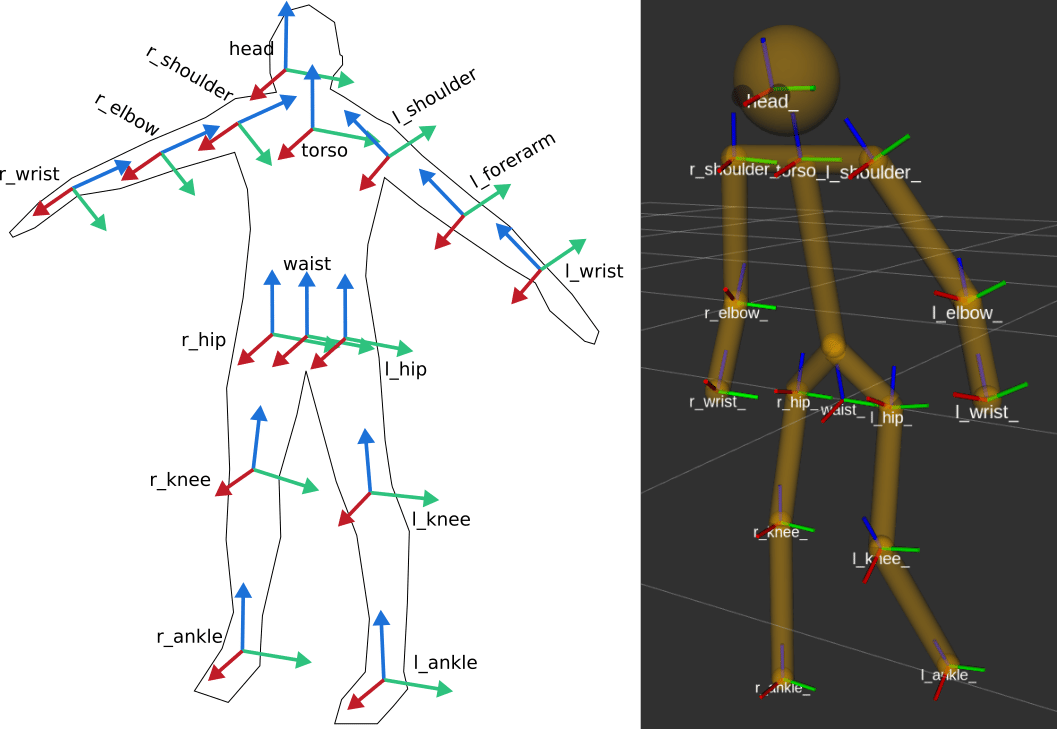
Full Body Frame Hierarchy
Wuji Glove’s frame system follows the REP-155 human skeleton model, defining a complete kinematic chain from the body root node to the fingertips. The glove currently uses the arm chain portion (from wrist downward). Frame definitions:Glove Sensor Frame Hierarchy
Below the wrist node, the glove mounts two child frames:- emf_tx: back-of-hand transmitter coil frame, serving as the reference origin for EMF spatial tracking
- palm_imu_link: Palm IMU frame, used for orientation estimation
tf_static data stream at 1Hz, with parent frame {l/r}_wrist.
Coil Coordinate Frames
Definition
EMF spatial tracking uses two types of coils:- Back-of-hand transmitter coil: housed inside the back-of-hand module enclosure, corresponding to the
emf_txframe (published viatf_staticat 1 Hz), serving as the reference origin for EMF spatial tracking. - Finger receiver coils: one set embedded in each fingertip enclosure (5 sets total). These are not published as standalone frames. Their positions are computed by EMF pose estimation (
emf_poses) and reported in theemf_txframe.
wrist, receivers follow the corresponding fingertip frame) — only a translational component exists relative to the parent, with no rotation.
Coil Position Parameters
The following measurements reference the right-hand design, with values rounded to account for manufacturing tolerances. From the wearer’s perspective, with the hand naturally open:Back-of-Hand Transmitter Coil
Finger Receiver Coil
“Left/right” is defined with the thumb fully extended pointing left. Left-hand glove data is mirrored from the right hand, with the Y direction inverted.